
Introduction of the Judicial Office Building



- Publication Date:
- Last updated:2026-01-20
- View count:555
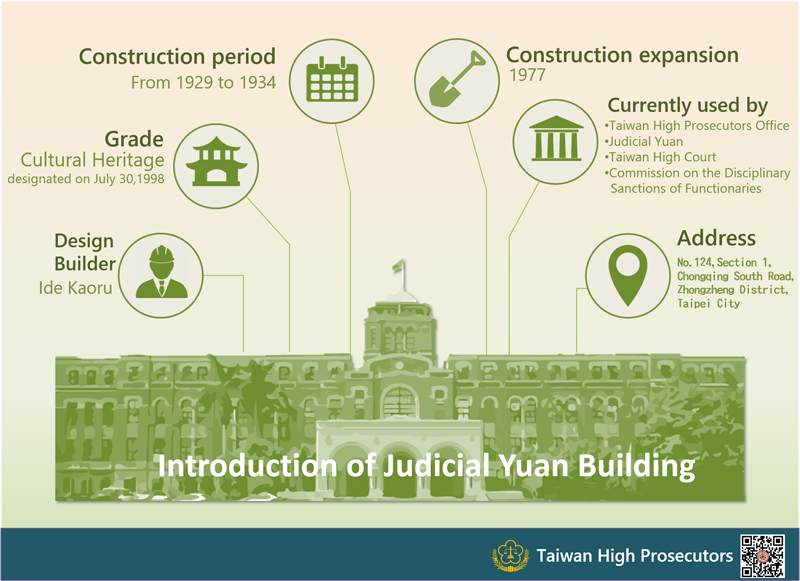
The Judicial Office Building was built during the Japanese Rule in the 1930s, located in the Bo'ai Special Zone, Zhongzheng District, adjacent to the south of the Presidential Office Building. The current site of the Judicial Office Building is near the Taipei South Gate (Zhongxi Gate), where a martial temple dedicated to Guan Yu was built while Taipei City was under constructing during the Qing Dynasty (the former site of the Taipei Confucius Temple was located opposite site of the martial temple, where the Taipei First Girls' High School campus is located in nowadays).
In 1929, the martial temple was demolished to build a courthouse. After five years, the courthouse was completed and opened in 1934, and named the Taiwan Governor-General's High Court. It housed the Taiwan High Court, the Taipei District Court, the Prosecutor's Office, and other agencies. After Taiwan's retrocession and the relocation of the Republic of China (R.O.C.) government to Taiwan, the Judicial Yuan and the Supreme Court moved into the courthouse in 1950 (the 39th year of the ROC), and the building was renamed the Judicial Office Building.
The Judicial Office Building was designed by Ide Kaoru(井手薰), who was both the former head of the Construction and Maintenance Section of the Governor-General's Office and the former president of the Taiwan Architectural Association.
The Judicial Office Building is constructed of partially steel framing and partially reinforced concrete. The overall layout of the building follows a plan of symmetrical configuration shaped like the character “日”(sun), that is similar to the neighboring Presidential Office Building (which was formerly used as the Taiwan Governor-General’s Office during the Japanese Rule). The Judicial Office Building consists of a tall central tower connecting to lower-raised buildings on both sides symmetrically, with two large courtyards sit separately in the north and south.
The main entrance of the building features three arched portals with basket-style capitals carved with decorative motifs, reflecting a Renaissance influence. The workmanship is meticulous, elegant without being overly ornate. The exterior walls of the building are clad in light green tiles, and the façade is lined with arched windows, showing elements of Islamic (Arab) architecture.
The curved, upturned lines of the central tower’s roof resemble a military helmet and evoke the image of traditional Japanese eaves. Some interpret the design as a metaphor for the authoritarian mindset of Japanese rule. A Japanese imperial chrysanthemum emblem was originally inlaid into the front wall of the central tower. It was replaced by a clock after the post-war restoration.
The Judicial Office Building was originally constructed with three stories. The fourth floor was built in 1977 to serve as offices for the Grand Justices and the Constitutional Court. Each floor of the Judicial Office Building has approximately 5,950 square meters of floor space.
When a visitor ascends the broad staircase from the main entrance of the Judicial Office Building, he enters the main hall. Inside the main hall stand twelve octagonal marble columns, giving rise to the name “Column Hall.” After the visitor progresses through the Column Hall, turns left and walks down the corridor encircling the atrium, he then arrives at the office buildings of the Taiwan High Prosecutors Office.
The Judicial Office Building was designated as a national historic monument on July 30, 1998.
The History and Features of the Judicial Office Building
- Classification: National historic monument (Designated as a national historic monument on July 30, 1998)
- Address: No. 124, Section 1, Chongqing South Road, Zhongzheng District, Taipei City
- Designer and Builder: Kaoru Ide(井手薰)
- Construction Period: Construction began in 1929; completed in 1934
- Additions: 1977
- Current Users: Taiwan High Prosecutors Office, Judicial Yuan, Taiwan High Court, and Disciplinary Court